 |
| photo from the S.F. Examiner - April 7, 1963 |
Sonja may have made mistakes but failing to pick up her 10-month-old son Kim after she left work on Friday was not one of them.
Single mom Sonja had a full-time (Mon-Fri) job as a secretary at the Blue Ribbon Meat Company, in Sparks, NV and on weekends she worked as a ski instructor at Slide Mountain Ski School. All of this effort paid the bills but left Sonja very little time with Kim so she'd grab what moments she could and leave him in the care of Sparks resident Mary Nielsen for the larger majority of the time.
It was expected of Sonja to pop over to Mary's on her lunch break or even after work on weekdays.
Every Friday, Sonja would pick Kim up from Mary's place and return him to her before clocking in at the Ski School. She would never not come on a Friday night, it was too important to her, so on April 5th when Sonja didn't come by, Mary was concerned.
Mary phoned Sonja's apartment twice that evening, between 5 and 5:30. Both times a man picked up and said "Hello." At first, Mary assumed she'd dialed the wrong number so she hung up and dialed again but when the same man answered the phone, Mary asked "Is Sonja there?" He replied "No she isn't" and suggested that she had dialed the wrong number. Maybe once but twice?
Hours passed and still no sign of Sonja. Sure that something was wrong, Mary phoned the police.
At 10:30 PM, Police Officer Mort Ammerman arrived at the duplex at 2640 Yori Avenue to perform a wellness check.
 |
| photo from the SF Examiner - April 8, 1963 |
He knocked on the door. Nobody answered. He was about to walk away but decided to test the door handle. It wasn't locked. Ammerman entered and announced himself. No response. The apartment was dark - Ammerman needed his flashlight.
The beam of light landed on several razor blades on the floor and dark stains on the carpet. He flicked the light switch on and proceeded with caution.
Two feet inside the door was a human heart. Ammerman could clearly see bloody clothes and bedding in the center of the room. He picked up the blanket and out rolled a severed human foot, covered in blood.
Then, as Officer Ammerman would later testify to in court, "I saw a hope chest along the rear wall of the living room with what appeared to be a wax figurine or dummy in it ... it had a waxy appearance."
 |
| Photo from the Daily News - February 28, 1971 |
Ammerman phoned it in to the shift captain and the detectives were dispatched.
Police Chief Elmer A. Briscoe described it as "The most brutal murder I've ever investigated" and said that his officers "couldn't help gagging at what they saw."
It was so horrible that the looky-loos showed up to see it for themselves.
 |
| Reno Gazette Journal image |
Sonja's mutilated, practically nude body had been stuffed inside. She had been decapitated and her head, wrapped in a lace tablecloth, was underneath the body. Sonja had a long gash down the front of her body, from her neck to her abdomen. (To be expected since they'd already found her heart on the carpet.) An attempt had been made to cut off her right leg but, because the work had not been completed, police speculated the killer was interrupted.
Police bagged evidence, impounded her car, dusted for prints, took photos of the multiple bloody footprints on the floor and found a garrote, made from strong 31" baling twine and two clothespins, in Sonja's closet.
Police also left with Sonja's diary (which covered the years 1961 and 1962 only) and a little black book with poetry, written by the victim. Early newspaper reports indicated Sonja's diary contained details of men whom she had been intimate with. Every man mentioned was brought in for questioning. Anyone of them could be the killer. As Chief Briscoe said, "We have to suspect everyone because we have no one to suspect."
There was no sign of forced entry. Her bed, now covered with a huge bloodstain, had been slept in. None of the neighbors heard anything unusual. There was a strong possibility that Sonja knew her killer. They would need to interview her friends, family, coworkers, neighbors, etc. They would collect fingerprint and footprint samples from Sonja's known associates.
The two most obvious people of interest were Sonja's ex-husband Jeff Schmidt, a 31-year-old Physical Education senior at Chico State College in California, and David C. Conrad. The latter, a 24-year-old University of Nevada graduate assistant in the English Dept, was named in a paternity suit filed by Sonja on October 12, 1962.
Sonja was seeking assistance with hospital costs related to the birth plus "reasonable" child support; Conrad denied being the father of Kim McCaskie. Judge Grant L. Bowen had heard the case one week prior but was now holding off on his decision because of the murder investigation.
 |
| photo from the SF Examiner April 8, 1963 |
Jeff and Sonja were married in 1956. They had a son together, William Schmidt, born in 1957. At the time of Sonja's death, William was living with Jeff's parents and Jeff was engaged to another woman, Carol Taylor. They were to be married in June.
Jeff Schmidt revealed to police that Sonja was already the mother of a year old baby girl when they became engaged and that a condition of the marriage was that the child be put up for adoption. (Now, I rarely make personal comments on the behavior of those involved in these crimes, but I simply find this wrong. Especially as their marriage didn't work out. Still, Sonja could always have said "No" to this concession and, to be fair, I know next to nothing about Jeff Schmidt.)
Quite quickly, both Jeff Schmidt and David C. Conrad passed their polygraph tests as did another five of Sonja's friends.
Ironically, all of the suspects in this case sat in the same room and the same chair that Sonja had sat in only 48 hours prior when she submitted to a lie-detection test in connection with her paternity suit.

Selmi was a part owner in the Blue Ribbon Meat Company, where Sonja worked, and his name had come up during his interview with Sonja a few days prior.
 |
| photo of Frank Selmi from a 1968 newspaper ad Blue Ribbon Meat Co |
While this might make Selmi a viable suspect, he could prove he was out of town when Sonja was killed.
In fact, it was Sonja who dropped Selmi at the Reno Airport a week prior so that he could board a plane to Arizona. She had also agreed to pick him up upon his return but she was a no show at 7:30 PM Friday, April 5th.
Selmi took a cab home then drove his own car over to Sonja's but didn't stop because of all the police activity. Instead, he phoned police headquarters, identified himself by name then lied about his current location, preferring to place himself, not in Reno but 40 minutes away in the town of Verdi. He later admitted to the deception.
The medical forensics would take at least a week to process. As Dr. James Decker, one of the case's pathologists, stated "It's a pretty messy thing." Another doctor confided, "There's so much mutilation, it's hard to pick one wound."
This much was known, Sonja's hyoid bone was fractured and there were petechial hemorrhages in her eyes. Clearly she'd been strangled but it was unsure if that was what killed her. (Pathologists would ultimately confirm that cause of death was strangulation.)
Investigators had plenty to do while waiting for those reports and to hear back from the FBI, to whom the Reno Police sent 12 sets of fingerprints.
Selmi took a cab home then drove his own car over to Sonja's but didn't stop because of all the police activity. Instead, he phoned police headquarters, identified himself by name then lied about his current location, preferring to place himself, not in Reno but 40 minutes away in the town of Verdi. He later admitted to the deception.
The medical forensics would take at least a week to process. As Dr. James Decker, one of the case's pathologists, stated "It's a pretty messy thing." Another doctor confided, "There's so much mutilation, it's hard to pick one wound."
This much was known, Sonja's hyoid bone was fractured and there were petechial hemorrhages in her eyes. Clearly she'd been strangled but it was unsure if that was what killed her. (Pathologists would ultimately confirm that cause of death was strangulation.)
Investigators had plenty to do while waiting for those reports and to hear back from the FBI, to whom the Reno Police sent 12 sets of fingerprints.
 |
| Police Chief Briscoe and District Attorney Raggio show the press a replica of the garotte used - Reno Gazette Journal photo, 1963 |
I'll put asterisks after the things that you'll want to be remember.
-Sonja had stopped off at Mary Nielsen's after work on Thursday to see her son Kim. Mary Nielsen had noticed Sonja was in possession of a small, expensive German 35mm camera. (*)
-Sonja had chatted over the back fence with her neighbors, Mr. and Mrs. Buddy LaPata, around 5 PM Thursday evening.
-Sonja phoned her good friend Beverly Frickstad on Thursday evening around 9:30. They spoke for roughly 35 minutes during which Sonja complained about how bright the new yellow paint on her walls was and she wondered if she'd made a mistake in choosing it. They made plans for the weekend. Sonja said she was tired after hours of painting and would be heading to bed soon.
-Thomas Baskas, who occupied the adjoining duplex apartment, saw Sonja hanging some clothes out to dry around 10:20 PM. (*) Thomas would tell reporter Lehnhoff Furgeson of the San Francisco Examiner, "I don't understand how anybody could do that and nobody hear a thing. She was such a big girl and husky. She could whip a man. This makes Jack the Ripper look like an amateur."
-Sonja had stopped off at Mary Nielsen's after work on Thursday to see her son Kim. Mary Nielsen had noticed Sonja was in possession of a small, expensive German 35mm camera. (*)
-Sonja had chatted over the back fence with her neighbors, Mr. and Mrs. Buddy LaPata, around 5 PM Thursday evening.
-Sonja phoned her good friend Beverly Frickstad on Thursday evening around 9:30. They spoke for roughly 35 minutes during which Sonja complained about how bright the new yellow paint on her walls was and she wondered if she'd made a mistake in choosing it. They made plans for the weekend. Sonja said she was tired after hours of painting and would be heading to bed soon.
-Thomas Baskas, who occupied the adjoining duplex apartment, saw Sonja hanging some clothes out to dry around 10:20 PM. (*) Thomas would tell reporter Lehnhoff Furgeson of the San Francisco Examiner, "I don't understand how anybody could do that and nobody hear a thing. She was such a big girl and husky. She could whip a man. This makes Jack the Ripper look like an amateur."
-Thomas's wife Mary Ruth weighed in, "We were here all night. I wondered why her drapes were pulled. She never left the drapes closed. It's ridiculous that we didn't hear anything because we often could hear her hi-fi." (*)
-About 11:30 PM Thursday, ski school operator George Hogan and his wife stopped by Sonja's duplex to deliver her $39.00 paycheck. He knocked but there was no response so he slipped the check under the door. Police found it there the next day and sent it off to the FBI for fingerprint analysis.
-Neighbors reported seeing the lights in Sonja's apartment on at 1:30 AM but they were not on when Officer Mort Ammerman arrived later that night.
-One neighbor reported hearing a car leaving her apartment shortly before dawn Friday morning. (*) Yet, the vehicle was back in place when police found her body. Although, the car described as Sonja's "pride and joy" had some damage to the right rear tire. (*)
-Sonja failed to show up for work on Friday.
-Sonja failed to pick her son up from the sitter on Friday.
-At 10:30 PM on Friday, Sonja is found dead.
The press had a field day with this case because it had so much going for it.
In addition to the gruesome state of the victim's body, the crime had a sexual component - pathologists would later confirm that Sonja had been raped.
Sonja was a young, attractive blue-eyed blonde and, as the public would soon believe, possibly promiscuous.
D.A. William Raggio announced in a news conference that after reading Sonja's diary it was evident she had "a very disturbed, complex personality" and "I got the impression that she was not too proud of some of her male companions" but he refused to divulge any of the diary entries as he felt it contained things that were unknown to her family. This, of course, left the press and the public to imagine what she'd written and they assumed the worst.
 |
| photo from the SF Examiner - April 10, 1963 |
He did share with the public two of Sonja's poems - one, from July 2, 1960, called "Love" and another, from October 1961, called "Death."
He also shared the fact that Sonja had at times contemplated suicide. Sonja's diary and poems were being analyzed by experts.
I'm sure they were just desperate for clues but it does sound like victim blaming.
Those who actually knew Sonja described her as someone who was a nice girl and quiet. A dedicated skier, a good worker, well-liked and respected. She was anything but a loose woman or a party girl.
Much was made of this disparity in the press following D.A. Raggio's press conference concerning the diary.
 |
| William Raggio |
The front page contained the headline "Scores of Men in Sonja's Diary" and attributed that quote to the District Attorney.
The second article was called "The Various Faces of Sonja." In it, Sonja was described as "an enormous puzzle" to Reno Police and they indicated she had a Jekyll and Hyde personality.
It wasn't a complete condemnation of Sonja, most of the article showed Sonja in a favorable light, but it was quite a change from the "Portrait of a Quiet Girl" article that appeared in their paper 2 days earlier.
The District Attorney, who would later deny saying anything inflammatory, tried to undo any damage he may have done but it was too late.
On April 13, 1963, Sonja's reputation was defended, from the pulpit, by Father Frank S. Evans, pastor of the United Church of Christ in Squaw Valley. "I decry what the police and press have done to the character of Sonja," he said after delivering the Easter sermon.
"With her searching spirit, I feel she was on the verge of becoming a Christian," he added. "While not a member of this congregation, this was her church."
(The United Church of Christ was built especially for the 1960 Olympics as a non-denominational chapel.)
A special memorial service - "open only to friends of Sonja" was scheduled for April 16th.
Father Evans had recently counseled Sonja and even baptized her illegitimate son, Kim, and was outraged by the news reports attacking her character. "Our purpose," said the minister, "is to try and undo all that has been done in the way of publicity."
Another thing the the press latched on to was the fact that Sonja wasn't just any pretty, 24-year-old, single mom. She was also a minor celebrity. Sonja had competed in the 1960 Winter Olympics games, as part of the British Ski Team.

Scottish-born Sonja along with her two older siblings (Guy and Jennifer) and their widowed mother had lived in the United States since 1946 but Sonja remained a British citizen. Even Sonja's choice of car was decidedly British; she drove a baby blue Triumph Sports Car.
When it announced that the 1960 Olympics would be held in nearby Squaw Valley, she applied for and was awarded a spot on the team. Sonja had been skiing since childhood. She'd hoped to race in the downhill, but they already had those 4 slots filled so she had to settle for the slalom.
Sonja slipped at one point during the race but got up and finished. Mother Dorothy, who was also an avid skier, was proud of Sonja, despite her last place finish. "Many never finish," after falling, Dorothy told reporters.
Following the Olympics, Sonja joined the British ski team, competed internationally and enjoyed more success than she had in Squaw Valley.
According to San Francisco Examiner ski writer Kit Carson White, who knew Sonja for several years, she'd been given a featured part in a commercially-produced movie on skiing by Warren Miller. I'm not sure which one of the 15 films Warren Miller released between 1950 and 1964 White is referring to.
Sonja had purchased the duplex a few months prior to her death and was in the process of fixing it up
At the time of her death, while still holding out hope that she could compete in the 1964 Olympics, Sonja seemed to be focusing on furthering her education and putting money away for the future.
One man took all of that away from her. That man was Thomas Lee Bean and the key to cracking this case was the camera Mary Neilsen had seen Sonja with on Thurday. Police couldn't find the camera in Sonja's apartment but she'd held on to the paperwork so they had the make, model and serial number.
Investigators visited pawn shops in the area and it was John Peevers, from the District Attorney's office, who finally found Sonja's camera. A young man had brought it in on April 6th and had been given $10.00 for it.
The name on the pawn slip was barely legible but it had only four letters and it looked like "Bean." Police visited the address written on the slip but learned Thomas Bean had moved. It didn't take long to find him though.
Thomas Lee Bean was already in the system.
In June of 1961, while living in Salt Lake City with his family, 16-year-old Thomas had been arrested after he broke into the screened bedroom of a neighbor and tried to strangle a sleeping 15-year-old girl. She screamed, clawed at his hands and frightened him off.
After being picked up by Salt Lake City Police, Thomas spent 15 days in a juvenile home were he was interviewed at length. A psychiatric evaluation showed that Thomas was "fairly sick" and in need of psychiatric treatment. According to Judge Regnal Garff Jr, the tests showed "the youth probably would have additional destructive outbursts and was unable to handle hostile and aggressive impulses."
Since the Bean family was planning to move to Las Vegas anyway, the case was turned over to the Nevada authorities with the understanding that Thomas receive the help he needed. This was fine with Thomas. He, apparently, wanted to be helped.
However, Thomas didn't check-in to the Nevada Youth Training Center in Elko until September 1961. He never received that much-needed psychiatric treatment and was back on the street in May of 1962.
Thomas Bean had been described a model student. The Center's superintendent, Oliver D. Forsterer told reporters, "He had one of the finest records of any of our boys." When confronted with the fact that Thomas's record indicated he needed psychiatric care, Forsterer admitted "We could see some disturbing signs when first came here but he adjusted well to the school - and we just can't afford a psychiatrist for the boys."
Less than one year after being released, on Saturday, April 13, 1963, Reno Police drove to the Bean residence at 4135 Neil Road, located 7 blocks from Sonja's duplex, and asked Thomas to accompany them to the police station. They didn't mention Sonja McCaskie at all, just the camera he had pawned. They told Thomas there was some technicality about minors being allowed to pawn items. Thomas Lee Bean was now 18 years old and an Earl Wooster High senior.
Thomas submitted to a lie detector test and spent 3 hours speaking with Dr. Rudolph Toller, a psychiatrist brought in by the District Attorney.
When Thomas was told they wanted his fingerprints and footprints, he became visibly anxious. News of bloody footprints being found in Sonja's apartment had been headline news.
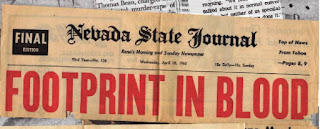
Police took their samples and began escorting Bean to an interview room, where the Police Chief and District Attorney were waiting to question him. Thomas saw a chance to escape and he took it. Bean bolted down the hallway and out the front door, with 15-20 police officers and the D.A. right behind him.
Two blocks and five warning shots later, Thomas surrendered. Thomas later asked an officer, "Who was that shooting at me? I wish they'd killed me."
Once in the interview room, police didn't have to work too hard to get Thomas to confess to killing Sonja. Apparently, he knew he was sunk when they asked for his footprint.
Thomas Lee Bean told police he was in the habit of prowling the neighborhood at night, looking to steal women's underwear that had been left out to dry on clotheslines. Thomas was doing just that on April 4, 1963. One woman saw what he was doing, shouted and scared him off. He didn't run home though - he just moved on.
It was Sonja's sports car that first caught his eye and although he saw some of her undergarments on the line, he didn't take them.
He thought he might instead see if her back door was open and it was. Thomas said he knew about fingerprints from watching television so he used a pair of previously purloined panties as a glove to turn the doorknob. He removed his shoes (he wasn't wearing socks), so that he might move about undetected, and proceeded to crawl around the apartment.
Thomas told police that if there had been a man in the apartment he would have left. The only person there was Sonja, asleep in her bed.
For someone who was only on a panty raid, you have to question that fact that Thomas had brought a garrote and a 10-inch butcher knife with him when he left the house that night.
Thomas slipped the rope around Sonja's neck and applied pressure. She woke with a start and begged for her life, telling him she had a young son. Thomas tightened his grip.
Thomas couldn't say for sure if Sonja was dead or alive when he raped her but he was pretty sure that her arm moved at one point and that he had heard her "gurgle." Then he broke out the knife.

Thomas dragged Sonja's body into her freshly-painted living room, turned on her stereo and proceeded to dismember her. (In case you're wondering what he might have listened to during the act - two LPs by The Brothers Four were mentioned in court but in the newspaper article that I read didn't specify which albums. The quartet had released 9 albums between 1960 and 1964.)
Bean wore a pair of Sonja's skiing mittens while carving her up to protect his hands. Finally, he stuffed her body in the hope chest. There were three knives stuck in Sonja's body when it was discovered. One was the knife Thomas had brought with him and the other two came from Sonja's kitchen.
He made a half-assed effort to clean up the blood then left her apartment with her camera and a radio.
Bean took her sports car for a joy ride and to dump his bloodstained shirt at the Windy Hill lovers lane. The right rear wheel of the Triumph was damaged slightly when he hit a rock. Thomas stopped for breakfast before returning the Triumph back to Sonja's apartment. He retrieved his own car, which he had parked a short distance away, then returned home.
After Tom's arrest, his father, Elza Bean, said he and this two sons both had bad colds so he didn't think it odd when Tom left the house Thursday night under the pretext of getting cough drops at the drug store but Tom didn't return home until between 7 and 7:30 Friday morning and he didn't bring home cough drops but rather a radio.
Elza said when he asked Tom about the radio, "He told me he got the radio from a man he helped with some horses."
They saw Friday's newspaper coverage of the killing and discussed it like they would any horrific crime but they didn't dwell on it. According to Elza, his son Tom was a slow reader who liked auto mechanics and cars. "He wanted to get his own automobile garage one day."
Elza Bean told reporters that "If (Tom) had gotten psychiatric help in Elko, which he should have, I don't see how this crime would ever have happened."
As much as Elza Bean tried to paint the picture of a happy family and a normal upbringing for his two sons, this simply was not so. Thomas Bean had issues with every member of his family.
Elza and Dorothy Bean, married in 1944 and ended their unhappy union in early 1962. Thomas viewed his petite, blond-haired mother, now living in California, as being weak for having stayed in the disastrous marriage for as long as she did. According to an alienist who would later testify for the prosecution, Thomas also hated his mother for allowing him to be shipped off to the facility in Elko.
Thomas resented his younger brother James for being his father's favorite, despite hating his father. Elza, apparently, could be erratic and cruel at times. Ex-wife Dorothy, now remarried, described Elza as "violent."
Money troubles and bad debts forced the family to constantly be on the move. They never stayed in one place for more than six months.
In March of 1947, Elza purchased a car in Illinois with a bad check in the amount of $595.00. Elza drove the car back to Las Vegas and immediately resold it to a used car dealer before his check bounced. Elza pled guilty to the fraudulent check charge and was sentenced to the state penitentiary for a period of 1 to 5 years.
Because of their nomadic lifestyle, Tom never really formed solid friendships and was pretty much a loner. He worked in the school cafeteria to pay for his lunches but didn't participate in outside school activities. The other children thought him odd. Conversely, Tom's younger brother James was described as popular and gregarious.
And it wasn't just the other children who thought there was something just not right with Thomas Lee Bean. Mrs. Hugo Cavalli, who said she had known Thomas "since he was 3 years old" seemed "to have a mean streak in him."
"It's a terrible thing to say," she added, "but I don't know a nice thing to say about him. He always seemed odd."
Both Mr. and Mrs. Cavalli might have had some valuable insights into the family dynamic because the Beans lived with the Cavallis for seven months in 1959 after the Bean family had returned to Nevada from "one of their numerous trips out of the state."
When Elza was asked what he thought about statements made by his former friends, he said "I think Mr. and Mrs. Cavalli would have been 100 percent better off, I'd have been better off and everybody concerned would have been better off if they'd stayed home and kept their mouths shut."
"Some of the things they said were true," he conceded, "some were not."
One of Thomas Bean's neighbors and schoolmate, Ann Halverson, remembered Tommy once told her he "hated blondes."
Thomas Lee Bean didn't just confess his crimes while in custody, he accompanied the police back to Sonja's apartment to re-enact the crime. All of which was recorded with a "sound motion picture camera." (At the bottom of this page, there's a link to a soundless 31 second video showing Bean exiting the apartment, preserved by British-Pathe.)
Then Bean showed them where he dumped his bloody clothing.
On April 29, 1963, Thomas Lee Bean was charged with murder.
Attorney Harry D. Anderson agreed to defend Bean and accepted $1.00 for his fee.
Despite his very detailed confession, Thomas Lee Bean still plead not guilty when asked. His defense would be insanity. The courts approved the payment up to $500, at the public's expense, "to enable the defendant to obtain the services of a qualified forensic psychiatrist."
This would be a battle of the psychiatrists.
The defense presented testimony recounting the early life of a disturbed youth but, as sad as his childhood was, there's no denying the fact that Thomas Bean thought to bring weapons with him when he went out that night and that he took measures to conceal his crime and avoid leaving behind evidence.
The prosecution presented mountains of physical evidence (nearly 100 exhibits including the hope chest) and argued that Bean couldn't be legally insane and still give that much thought to the commission of the crime.
Before the trial began, on May 23, 1963, Thomas attempted suicide by slashing one of his wrists. When Deputy Sheriff Lee Womack asked Bean why he had done it, Bean responded that "He had nothing to live for" and promised to "eventually finish the job."
On June 24, 1963, with Judge Grant L. Bowen presiding, jury selection began.
Bit of trivia - the first juror whose name was drawn was Albert Frost, a former deliveryman for a local appliance store. He was one of two men who delivered to Sonja McCaskie, the stereo system that Thomas Bean played while he carved up her body. Frost said this brief association would not impact his ability to serve as a juror as his only contact with Sonja was when he asked her to sign the receipt. After 30 minutes of questioning, he was rejected.
Curiously, the defense did not challenge the admission of full color photographs of the victim's body. I would think that today, those would be deemed prejudicial.
The prosecution opened it's case on June 27, 1963.
Thomas Bean did not testify on his own behalf.
Defense witness Dr. David Wilson testified that Thomas Bean had never had relations with a woman until the moment Sonja McCaskie was assaulted.
On July 1, 1963, the prosecution read to the jury excerpts from Bean's 66 page confession including these passages -
"You ask the motive, I have none. It's been a childhood dream to rape a girl, and I don't know why. I've tried to kick it."
"I don't know why I cut her up. I don't...I just shoved the knife in and started to cut that's all. I don't know why I cut her heart out. It was stupid."
"I had no reason for doing it. Maybe raping her but not killing her."
Tom had admitted to spending roughly 4 hours with Sonja's corpse.
On July 2, 1963, a fellow schoolmate and cafeteria coworker named Patsy Willis took the stand.
Patsy told the jury that she and Tom had been out socially - three consecutive days following the death of Sonja McCaskie.
Patsy testified that on Monday, April 8th, Tom had mentioned the killing to her and his desire to protect himself because he lived in that neighborhood. They were out driving and Tom stopped by his house to "pick up a couple of guns." She then identified these weapons in court.
On Tuesday, April 9th, they had driven to Lake Tahoe for picnic and some target shooting. Later that day, Tom gave her a pistol, suggesting she keep it for protection.
On Wednesday, April 10th, Tom again took her for a car ride. They traveled along some of the same roads that Tom had driven on in Sonja's Triumph and Tom showed Patsy where he'd gone off the road but he didn't reveal he'd been driving a dead woman's car. Patsy identified this area from photos the prosecution presented to her.
Patsy described Thomas Bean as a pleasant date and a gentleman. She sobbed as she left the witness box.
Later that day, Thomas Bean again tried to kill himself by reopening the wound on his wrist.
The trial continued without delay, although on July 3rd the jury was made aware of the suicide attempts.
The court took a four day recess to celebrate the July 4th holiday and the case resumed on Monday, July 8th. Final arguments were heard, the jury received its instructions from the judge and after 75 mins of deliberation, the verdict was in - guilty of first degree murder.
As the jury members exited the box, Thomas Bean pushed his chair back, looked at them and bitterly muttered "Thanks."
That verdict came with a mandatory death sentence. The jury was okay with that.
Sentencing was set for July 15, 1963. Everyone knew what the judge would say; it was simply a matter of setting a date for Bean's death. Judge Grant L. Bowen set the execution for the week of September 23, 1963 but naturally, the first of many appeals put that on hold.
One year later, Dorothy McCaskie was asked for her opinion. She had this to say, "Personally, without any malice, I hope he gets the death penalty. If not, I'm afraid he might get out after 20 years or so and do something like that again. I'd hate to see anyone else have to go through that."
One of these appeals proved successful. In 1970, the Nevada Supreme Court upheld the conviction but overturned the death penalty. It seems that any juror in the original trial who had expressed an opposition to the death penalty was rejected.
Another penalty trial was held. This time the jury took 8 hours to come to their decision but the answer, given on December 2, 1970, was the same - Thomas Bean was to die in the gas chamber.
Fortunately for Bean, he was still around in 1972 when the U.S. Supreme Court decided the death penalty was unconstitutional and overturned all death sentences. His sentence was commuted to life in prison. To this day he remains in a medium-security prison and is Nevada's longest-serving inmate.
In 2013, The Reno Gazette-Journal requested to interview Bean but their request was denied. The DOC issued this statement, "The Nevada Department of Corrections does not allow recorded interviews of inmates for entertainment purposes."
The DOC also refused a request to interview Bean without recording it.
The newspaper had to settle for an interview with Joe Elliott, who became acquainted with Bean while working in the prison system as a teacher. Here's an excerpt from that interview on April 3, 2013:
Bean sometimes talked about the motive for the McCaskie murder, although generally he did not like to talk about it. When Bean was 6-years-old, his mother had a lot of male visitors, Elliott said. That's when the seeds of his fantasy were planted.
"When he first had sex with anybody, he was going to kill that person," Elliott said. He said that Bean thought about it for 12 years. Then he finally acted on that fantasy.
Joe Elliott, who had served as an assemblyman in the Nevada Legislature in 1991, said that despite Bean's pleasant demeanor, if he had a say in it, he would never let Bean out of prison.
Today, Sonja McCaskie's hope chest sits in a Reno evidence room and will remain there until Thomas Bean dies.
Sonja Yvonne McCaskie was cremated and her ashes interred in Trail's End Cemetery in Tahoe City, California.
What became of Sonja's son Kim? Immediately following Sonja's death, her older sister Jennifer and her husband Paul K. Arthur made arrangements to adopt him. And while I can't be 100% certain it's him, I do see a Cal-Davis University student named Kim Arthur mentioned fairly often in the 1984 sports pages as competing in various skiing events. I'd like to think it's him.

 A September 8, 1963 edition of the National Enquirer, with Sonja's murder as the cover story, included actual autopsy photos and is still remembered as a low point in the publication's history. The headline screamed "I cut out her heart and stomped on it."
A July 2011 blog entry, concerning this case and in particular some improper behavior on the part of the police, was posted by Dennis Myers, news editor of the Reno News and Review. It can be found here - http://www.newsreview.com/reno/newsview/blogs/post?oid=2902391
It explains how the press got ahold of this photo of Sonja and used it to sensational advantage.
No wonder Dorothy McCaskie was disappointed with the way her murdered daughter was being portrayed.
And not that this is relevant to the story, but it's worth acknowledging, if I'm right - Sonja's older brother Guy McCaskie is a highly respected and legendary birder, field ornithologist and author.
If you're interested in knowing more, here's a biographical piece on Guy (but only as it relates to his field of study) - http://creagrus.home.montereybay.com/CAwhoGMcC.html.
It is a bit out of date though. As recently as May 2019, Guy recorded his 500th species of bird, in this country - the Hudsonian Godwit.
And finally, here is the link to the British-Pathe video showing Thomas Bean exiting Sonja's duplex, after describing to authorities how he killed her. He doesn't look especially remorseful, which makes us hate him all the more. -
https://www.britishpathe.com/video/VLVA5ON5QIEF6AOW2F0FXKHXPSK68-USA-RENO-YOUTH-CHARGED-WITH-SKI-GIRL-KILLING
Update - I've heard from someone that the British-Pathe video didn't run for her after following the link. Just in case she's not the only one, I've upload it to the As Close to Crime YouTube channel. You can find the video at this address - https://youtu.be/C3SChL5NLW0
It wasn't a complete condemnation of Sonja, most of the article showed Sonja in a favorable light, but it was quite a change from the "Portrait of a Quiet Girl" article that appeared in their paper 2 days earlier.
The District Attorney, who would later deny saying anything inflammatory, tried to undo any damage he may have done but it was too late.
On April 13, 1963, Sonja's reputation was defended, from the pulpit, by Father Frank S. Evans, pastor of the United Church of Christ in Squaw Valley. "I decry what the police and press have done to the character of Sonja," he said after delivering the Easter sermon.
"With her searching spirit, I feel she was on the verge of becoming a Christian," he added. "While not a member of this congregation, this was her church."
 |
| Vintage postcard of the United Church of Christ |
A special memorial service - "open only to friends of Sonja" was scheduled for April 16th.
Father Evans had recently counseled Sonja and even baptized her illegitimate son, Kim, and was outraged by the news reports attacking her character. "Our purpose," said the minister, "is to try and undo all that has been done in the way of publicity."
Another thing the the press latched on to was the fact that Sonja wasn't just any pretty, 24-year-old, single mom. She was also a minor celebrity. Sonja had competed in the 1960 Winter Olympics games, as part of the British Ski Team.

Scottish-born Sonja along with her two older siblings (Guy and Jennifer) and their widowed mother had lived in the United States since 1946 but Sonja remained a British citizen. Even Sonja's choice of car was decidedly British; she drove a baby blue Triumph Sports Car.
When it announced that the 1960 Olympics would be held in nearby Squaw Valley, she applied for and was awarded a spot on the team. Sonja had been skiing since childhood. She'd hoped to race in the downhill, but they already had those 4 slots filled so she had to settle for the slalom.
Sonja slipped at one point during the race but got up and finished. Mother Dorothy, who was also an avid skier, was proud of Sonja, despite her last place finish. "Many never finish," after falling, Dorothy told reporters.
Following the Olympics, Sonja joined the British ski team, competed internationally and enjoyed more success than she had in Squaw Valley.
 |
| photo from SF Examiner - April 7, 1963 |
Sonja had purchased the duplex a few months prior to her death and was in the process of fixing it up
At the time of her death, while still holding out hope that she could compete in the 1964 Olympics, Sonja seemed to be focusing on furthering her education and putting money away for the future.
One man took all of that away from her. That man was Thomas Lee Bean and the key to cracking this case was the camera Mary Neilsen had seen Sonja with on Thurday. Police couldn't find the camera in Sonja's apartment but she'd held on to the paperwork so they had the make, model and serial number.
Investigators visited pawn shops in the area and it was John Peevers, from the District Attorney's office, who finally found Sonja's camera. A young man had brought it in on April 6th and had been given $10.00 for it.
The name on the pawn slip was barely legible but it had only four letters and it looked like "Bean." Police visited the address written on the slip but learned Thomas Bean had moved. It didn't take long to find him though.
Thomas Lee Bean was already in the system.
In June of 1961, while living in Salt Lake City with his family, 16-year-old Thomas had been arrested after he broke into the screened bedroom of a neighbor and tried to strangle a sleeping 15-year-old girl. She screamed, clawed at his hands and frightened him off.
After being picked up by Salt Lake City Police, Thomas spent 15 days in a juvenile home were he was interviewed at length. A psychiatric evaluation showed that Thomas was "fairly sick" and in need of psychiatric treatment. According to Judge Regnal Garff Jr, the tests showed "the youth probably would have additional destructive outbursts and was unable to handle hostile and aggressive impulses."
Since the Bean family was planning to move to Las Vegas anyway, the case was turned over to the Nevada authorities with the understanding that Thomas receive the help he needed. This was fine with Thomas. He, apparently, wanted to be helped.
However, Thomas didn't check-in to the Nevada Youth Training Center in Elko until September 1961. He never received that much-needed psychiatric treatment and was back on the street in May of 1962.
Thomas Bean had been described a model student. The Center's superintendent, Oliver D. Forsterer told reporters, "He had one of the finest records of any of our boys." When confronted with the fact that Thomas's record indicated he needed psychiatric care, Forsterer admitted "We could see some disturbing signs when first came here but he adjusted well to the school - and we just can't afford a psychiatrist for the boys."
Less than one year after being released, on Saturday, April 13, 1963, Reno Police drove to the Bean residence at 4135 Neil Road, located 7 blocks from Sonja's duplex, and asked Thomas to accompany them to the police station. They didn't mention Sonja McCaskie at all, just the camera he had pawned. They told Thomas there was some technicality about minors being allowed to pawn items. Thomas Lee Bean was now 18 years old and an Earl Wooster High senior.
 |
| Reno Gazette Journal image - Brodhead, Bean and Raggio |
When Thomas was told they wanted his fingerprints and footprints, he became visibly anxious. News of bloody footprints being found in Sonja's apartment had been headline news.

Police took their samples and began escorting Bean to an interview room, where the Police Chief and District Attorney were waiting to question him. Thomas saw a chance to escape and he took it. Bean bolted down the hallway and out the front door, with 15-20 police officers and the D.A. right behind him.
Two blocks and five warning shots later, Thomas surrendered. Thomas later asked an officer, "Who was that shooting at me? I wish they'd killed me."
Once in the interview room, police didn't have to work too hard to get Thomas to confess to killing Sonja. Apparently, he knew he was sunk when they asked for his footprint.
Thomas Lee Bean told police he was in the habit of prowling the neighborhood at night, looking to steal women's underwear that had been left out to dry on clotheslines. Thomas was doing just that on April 4, 1963. One woman saw what he was doing, shouted and scared him off. He didn't run home though - he just moved on.
 |
| Reno Gazette Journal photo |
He thought he might instead see if her back door was open and it was. Thomas said he knew about fingerprints from watching television so he used a pair of previously purloined panties as a glove to turn the doorknob. He removed his shoes (he wasn't wearing socks), so that he might move about undetected, and proceeded to crawl around the apartment.
Thomas told police that if there had been a man in the apartment he would have left. The only person there was Sonja, asleep in her bed.
For someone who was only on a panty raid, you have to question that fact that Thomas had brought a garrote and a 10-inch butcher knife with him when he left the house that night.
Thomas slipped the rope around Sonja's neck and applied pressure. She woke with a start and begged for her life, telling him she had a young son. Thomas tightened his grip.
Thomas couldn't say for sure if Sonja was dead or alive when he raped her but he was pretty sure that her arm moved at one point and that he had heard her "gurgle." Then he broke out the knife.

Thomas dragged Sonja's body into her freshly-painted living room, turned on her stereo and proceeded to dismember her. (In case you're wondering what he might have listened to during the act - two LPs by The Brothers Four were mentioned in court but in the newspaper article that I read didn't specify which albums. The quartet had released 9 albums between 1960 and 1964.)
Bean wore a pair of Sonja's skiing mittens while carving her up to protect his hands. Finally, he stuffed her body in the hope chest. There were three knives stuck in Sonja's body when it was discovered. One was the knife Thomas had brought with him and the other two came from Sonja's kitchen.
He made a half-assed effort to clean up the blood then left her apartment with her camera and a radio.
Bean took her sports car for a joy ride and to dump his bloodstained shirt at the Windy Hill lovers lane. The right rear wheel of the Triumph was damaged slightly when he hit a rock. Thomas stopped for breakfast before returning the Triumph back to Sonja's apartment. He retrieved his own car, which he had parked a short distance away, then returned home.
 |
| photo from the Reno Gazette Journal, April 16, 1963 |
Elza said when he asked Tom about the radio, "He told me he got the radio from a man he helped with some horses."
They saw Friday's newspaper coverage of the killing and discussed it like they would any horrific crime but they didn't dwell on it. According to Elza, his son Tom was a slow reader who liked auto mechanics and cars. "He wanted to get his own automobile garage one day."
Elza Bean told reporters that "If (Tom) had gotten psychiatric help in Elko, which he should have, I don't see how this crime would ever have happened."
As much as Elza Bean tried to paint the picture of a happy family and a normal upbringing for his two sons, this simply was not so. Thomas Bean had issues with every member of his family.
Elza and Dorothy Bean, married in 1944 and ended their unhappy union in early 1962. Thomas viewed his petite, blond-haired mother, now living in California, as being weak for having stayed in the disastrous marriage for as long as she did. According to an alienist who would later testify for the prosecution, Thomas also hated his mother for allowing him to be shipped off to the facility in Elko.
Thomas resented his younger brother James for being his father's favorite, despite hating his father. Elza, apparently, could be erratic and cruel at times. Ex-wife Dorothy, now remarried, described Elza as "violent."
Money troubles and bad debts forced the family to constantly be on the move. They never stayed in one place for more than six months.
In March of 1947, Elza purchased a car in Illinois with a bad check in the amount of $595.00. Elza drove the car back to Las Vegas and immediately resold it to a used car dealer before his check bounced. Elza pled guilty to the fraudulent check charge and was sentenced to the state penitentiary for a period of 1 to 5 years.
Because of their nomadic lifestyle, Tom never really formed solid friendships and was pretty much a loner. He worked in the school cafeteria to pay for his lunches but didn't participate in outside school activities. The other children thought him odd. Conversely, Tom's younger brother James was described as popular and gregarious.
And it wasn't just the other children who thought there was something just not right with Thomas Lee Bean. Mrs. Hugo Cavalli, who said she had known Thomas "since he was 3 years old" seemed "to have a mean streak in him."
"It's a terrible thing to say," she added, "but I don't know a nice thing to say about him. He always seemed odd."
Both Mr. and Mrs. Cavalli might have had some valuable insights into the family dynamic because the Beans lived with the Cavallis for seven months in 1959 after the Bean family had returned to Nevada from "one of their numerous trips out of the state."
When Elza was asked what he thought about statements made by his former friends, he said "I think Mr. and Mrs. Cavalli would have been 100 percent better off, I'd have been better off and everybody concerned would have been better off if they'd stayed home and kept their mouths shut."
"Some of the things they said were true," he conceded, "some were not."
One of Thomas Bean's neighbors and schoolmate, Ann Halverson, remembered Tommy once told her he "hated blondes."
Thomas Lee Bean didn't just confess his crimes while in custody, he accompanied the police back to Sonja's apartment to re-enact the crime. All of which was recorded with a "sound motion picture camera." (At the bottom of this page, there's a link to a soundless 31 second video showing Bean exiting the apartment, preserved by British-Pathe.)
 |
| Reno Gazette Journal photo |
 |
| photo from The Times Tribune - April 15, 1963 |
 |
| Reno Gazette Journal - July 8, 1936 |
Despite his very detailed confession, Thomas Lee Bean still plead not guilty when asked. His defense would be insanity. The courts approved the payment up to $500, at the public's expense, "to enable the defendant to obtain the services of a qualified forensic psychiatrist."
This would be a battle of the psychiatrists.
The defense presented testimony recounting the early life of a disturbed youth but, as sad as his childhood was, there's no denying the fact that Thomas Bean thought to bring weapons with him when he went out that night and that he took measures to conceal his crime and avoid leaving behind evidence.
The prosecution presented mountains of physical evidence (nearly 100 exhibits including the hope chest) and argued that Bean couldn't be legally insane and still give that much thought to the commission of the crime.
Before the trial began, on May 23, 1963, Thomas attempted suicide by slashing one of his wrists. When Deputy Sheriff Lee Womack asked Bean why he had done it, Bean responded that "He had nothing to live for" and promised to "eventually finish the job."
On June 24, 1963, with Judge Grant L. Bowen presiding, jury selection began.
 |
| Reno Gazette Journal photo, July 3, 1963 |
Curiously, the defense did not challenge the admission of full color photographs of the victim's body. I would think that today, those would be deemed prejudicial.
The prosecution opened it's case on June 27, 1963.
Thomas Bean did not testify on his own behalf.
Defense witness Dr. David Wilson testified that Thomas Bean had never had relations with a woman until the moment Sonja McCaskie was assaulted.
On July 1, 1963, the prosecution read to the jury excerpts from Bean's 66 page confession including these passages -
"You ask the motive, I have none. It's been a childhood dream to rape a girl, and I don't know why. I've tried to kick it."
"I don't know why I cut her up. I don't...I just shoved the knife in and started to cut that's all. I don't know why I cut her heart out. It was stupid."
"I had no reason for doing it. Maybe raping her but not killing her."
Tom had admitted to spending roughly 4 hours with Sonja's corpse.
On July 2, 1963, a fellow schoolmate and cafeteria coworker named Patsy Willis took the stand.
Patsy told the jury that she and Tom had been out socially - three consecutive days following the death of Sonja McCaskie.
Patsy testified that on Monday, April 8th, Tom had mentioned the killing to her and his desire to protect himself because he lived in that neighborhood. They were out driving and Tom stopped by his house to "pick up a couple of guns." She then identified these weapons in court.
On Tuesday, April 9th, they had driven to Lake Tahoe for picnic and some target shooting. Later that day, Tom gave her a pistol, suggesting she keep it for protection.
On Wednesday, April 10th, Tom again took her for a car ride. They traveled along some of the same roads that Tom had driven on in Sonja's Triumph and Tom showed Patsy where he'd gone off the road but he didn't reveal he'd been driving a dead woman's car. Patsy identified this area from photos the prosecution presented to her.
Patsy described Thomas Bean as a pleasant date and a gentleman. She sobbed as she left the witness box.
Later that day, Thomas Bean again tried to kill himself by reopening the wound on his wrist.
The trial continued without delay, although on July 3rd the jury was made aware of the suicide attempts.
The court took a four day recess to celebrate the July 4th holiday and the case resumed on Monday, July 8th. Final arguments were heard, the jury received its instructions from the judge and after 75 mins of deliberation, the verdict was in - guilty of first degree murder.
As the jury members exited the box, Thomas Bean pushed his chair back, looked at them and bitterly muttered "Thanks."
That verdict came with a mandatory death sentence. The jury was okay with that.
Sentencing was set for July 15, 1963. Everyone knew what the judge would say; it was simply a matter of setting a date for Bean's death. Judge Grant L. Bowen set the execution for the week of September 23, 1963 but naturally, the first of many appeals put that on hold.
One year later, Dorothy McCaskie was asked for her opinion. She had this to say, "Personally, without any malice, I hope he gets the death penalty. If not, I'm afraid he might get out after 20 years or so and do something like that again. I'd hate to see anyone else have to go through that."
One of these appeals proved successful. In 1970, the Nevada Supreme Court upheld the conviction but overturned the death penalty. It seems that any juror in the original trial who had expressed an opposition to the death penalty was rejected.
Another penalty trial was held. This time the jury took 8 hours to come to their decision but the answer, given on December 2, 1970, was the same - Thomas Bean was to die in the gas chamber.
Fortunately for Bean, he was still around in 1972 when the U.S. Supreme Court decided the death penalty was unconstitutional and overturned all death sentences. His sentence was commuted to life in prison. To this day he remains in a medium-security prison and is Nevada's longest-serving inmate.
 |
| 2013 mugshot for Thomas Lee Bean |
The DOC also refused a request to interview Bean without recording it.
The newspaper had to settle for an interview with Joe Elliott, who became acquainted with Bean while working in the prison system as a teacher. Here's an excerpt from that interview on April 3, 2013:
Bean sometimes talked about the motive for the McCaskie murder, although generally he did not like to talk about it. When Bean was 6-years-old, his mother had a lot of male visitors, Elliott said. That's when the seeds of his fantasy were planted.
"When he first had sex with anybody, he was going to kill that person," Elliott said. He said that Bean thought about it for 12 years. Then he finally acted on that fantasy.
Joe Elliott, who had served as an assemblyman in the Nevada Legislature in 1991, said that despite Bean's pleasant demeanor, if he had a say in it, he would never let Bean out of prison.
Today, Sonja McCaskie's hope chest sits in a Reno evidence room and will remain there until Thomas Bean dies.
 |
| photo from the Reno Gazette Journal - February 18, 2002 |
Sonja Yvonne McCaskie was cremated and her ashes interred in Trail's End Cemetery in Tahoe City, California.
 |
| www.findagrave.com photo uploaded by Grave Finder |

 A September 8, 1963 edition of the National Enquirer, with Sonja's murder as the cover story, included actual autopsy photos and is still remembered as a low point in the publication's history. The headline screamed "I cut out her heart and stomped on it."
 A July 2011 blog entry, concerning this case and in particular some improper behavior on the part of the police, was posted by Dennis Myers, news editor of the Reno News and Review. It can be found here - http://www.newsreview.com/reno/newsview/blogs/post?oid=2902391
It explains how the press got ahold of this photo of Sonja and used it to sensational advantage.
 |
| photo from the SF Examiner - April 10, 1963 |
And not that this is relevant to the story, but it's worth acknowledging, if I'm right - Sonja's older brother Guy McCaskie is a highly respected and legendary birder, field ornithologist and author.
 |
| photo from www.thedesertsun.com |
It is a bit out of date though. As recently as May 2019, Guy recorded his 500th species of bird, in this country - the Hudsonian Godwit.
And finally, here is the link to the British-Pathe video showing Thomas Bean exiting Sonja's duplex, after describing to authorities how he killed her. He doesn't look especially remorseful, which makes us hate him all the more. -
https://www.britishpathe.com/video/VLVA5ON5QIEF6AOW2F0FXKHXPSK68-USA-RENO-YOUTH-CHARGED-WITH-SKI-GIRL-KILLING
Update - I've heard from someone that the British-Pathe video didn't run for her after following the link. Just in case she's not the only one, I've upload it to the As Close to Crime YouTube channel. You can find the video at this address - https://youtu.be/C3SChL5NLW0


