Why are you here and why am I doing this?

Why are you here and why am I doing this?

If you're like me, THIS is as close to crime as you want to get.

You want to maintain a safe distance and delve into it when it's convenient for you; not when some lunatic knocks on your door in the middle of the night, runs you off the road or approaches you in a parking lot.

Maybe you are a Murderino?

I'm someone who resolves every New Year's Eve to NOT be the victim of a crime.

Some of the crimes I'll describe here aren't horrific or even result in death, but they're still situations to be avoided. Who wants the drama or the paperwork associated with a non-violent crime? Not me.

I know I'm not the only one who's interested in reading about crime & criminals. I hope to use this blog to share that interest with others.

My process is to find something in an old newspaper, news broadcast or my own memory that grabs my attention and delve deep. I research the cases and people using newspaper and magazine archives, genealogy sites plus court or prison documents (when I can afford them). Lately the way I write the stories has changed. I'm starting to show the effort I've made to track down specific details. I also seem to be posting less frequently. This can be attributed to the fact that I'm now concerned with the As Close to Crime YouTube channel as well as my habit of falling deeper and deeper into rabbit holes with each new entry. I'd rather have quality than quantity, so I've come to terms with the lessening output.

I try not rely too heavily on other websites or books but I credit people when it's appropriate. In fact, if my main source of information is someone else's book, I'll just recommend the book. This was the case with "The Bobbed Haired Bandit."

Don't expect too many Top 10 lists from me. I instead prefer to select the more obscure crimes that some visitors to this blog have either never heard of or haven't thought about in awhile.

I also like to give attention to not just those who break the law but those who uphold the law. So you can expect to see some of that here.

There's a companion YouTube Channel for this blog, called As Close to Crime, where I occasionally post clips related to particular blog entries or just random clips concerning criminal activity. I'm never going to post an entire commercially available film.

Be sure to subscribe to the channel or this blog.

Search This Blog

Showing posts with label Brooklyn. Show all posts

Thursday, January 10, 2019

A Question of Morality

True Detective Magazine -
January 2015 
There was never any doubt about who killed 39-year-old George Hochfeld; it was his 32-year-old wife Martha Hochfeld.

True Detective Magazine -
January 2015 
The NYPD knew this because in the early hours of April 23, 1950, shortly after bashing in George's head with a heavy mahogany end table, Martha walked down to an all-night garage to use the pay phone and turn herself in.

Martha then walked back home to 839 Midwood Street in Brooklyn to wait for the police and to bring the two oldest of their five children, Loretta (aged 13) and Morton (aged 12), up to speed. Their father was dying, she was responsible and she had phoned the police. The three youngest children, Robert (aged 11), Phyllis (aged 7), and Jean (aged 5), were still asleep. George was transported to Kings County Hospital and died an hour later. Official cause of death was fractured skull and lacerated brain.

Again, there was no doubt as to who. The question before the court and the public was why had Mrs. Hochfeld killed her husband of 16 years?

Newspapers were quick to print what Martha had told police regarding her motivation and in no time headlines proclaiming George to be an abusive, "stingy husband" provided fodder for water cooler and dinner table debates about household finances and division of family funds.

At a time when the victim's family should have been mourning their loss, George's older brother Louis was writing a letter to the Daily News to defend his brother's character.

Louis wanted to respond to a letter published in the April 27, 1950 edition.

A "Mrs. M.D. of Manhattan" was writing to salute Martha Hochfeld - "God bless her! I wish more women had the courage to kill their lousy husbands that only give them a miserable allowance for themselves and the children, though they always have plenty of money for themselves. They should realize their duty to their families but they are mean, low and without principal, and all of them should have their skulls broken."

Louis Hochfeld's letter, appearing on May 4, 1950, implored Mrs. M.D. and others to wait for the evidence. Louis wrote "I would like to acquaint you with the true facts surrounding this brutal slaying. George Hochfeld was a fine and energetic man, always trying to keep his family well fed, well housed and well clothed. In due time the character of the dead man will be brought out. Until then, Mrs. M.D., please use your common sense, think of both sides, and suspend judgment."

What were the true facts?

Martha told police that she and George, an often-abusive prosperous junk dealer, were constantly quarreling about money and specifically the mere $20 a week George gave her. "The kids are filthy and he did not give me any money for food and clothing. I couldn't stand it anymore." The Hochfelds had 5 children, ranging in age from 5 years to 13 years, and another on the way. Their son, Joseph, had died in infancy on December 30, 1946.

Daily News,
April 24, 1950
George and Martha's last argument on the subject of money was the evening of Saturday April 22nd and it was all one-sided. George had been out of town for several days on a business trip and didn't want to discuss the matter with her when he got home. According to Martha, George was surly. He ate his dinner and went to bed. Martha lay beside George for a bit, brooding. Around 2:30 AM she rose, went into the living room and grabbed an end table. Martha came back into the bedroom and brought the table down on her sleeping husband's head three times. He never stirred. She dressed and walked to a pay phone.

When the police arrived she told them "I intended to kill him. It was him or me." George was 5 foot 8 inches and weighed roughly 200 pounds. Martha was 5 foot 4 inches and weighed 120 pounds.

True Detective Magazine - January 2015
Martha was interviewed at length by the police before being brought before Magistrate Albert Schanzer at the Brooklyn Felony Court. She told the court she had no money for a lawyer. Charles Schinitsky from the Legal Aid Society represented Martha at her April 26, 1950 arraignment. No plea was entered but Mr. Schinitsky told the court and the press that there were unexplained circumstances surrounding the slaying and that Martha would be "vindicated by a jury." He was half right. Martha was held without bail and her children sent to various shelters. 

On April 24, 1950, George Hochfeld was buried at new Montefiore Cemetery in West Babylon NY.
Daily News - April 25, 1950


On April 25, 1950, newspapers were revealing what they'd learned from Lt. Arthur Giddings of the Brooklyn Homicide Squad. The headlines read "Reveal Mrs. Hochfeld Was a Mental Patient." The reality was Martha had spent a week at Bellevue's Psychiatric Ward in February of 1943 before being released into her husband's custody. I believe this might have coincided with the birth of her daughter Phyllis. Perhaps Martha was suffering from some postpartum depression?

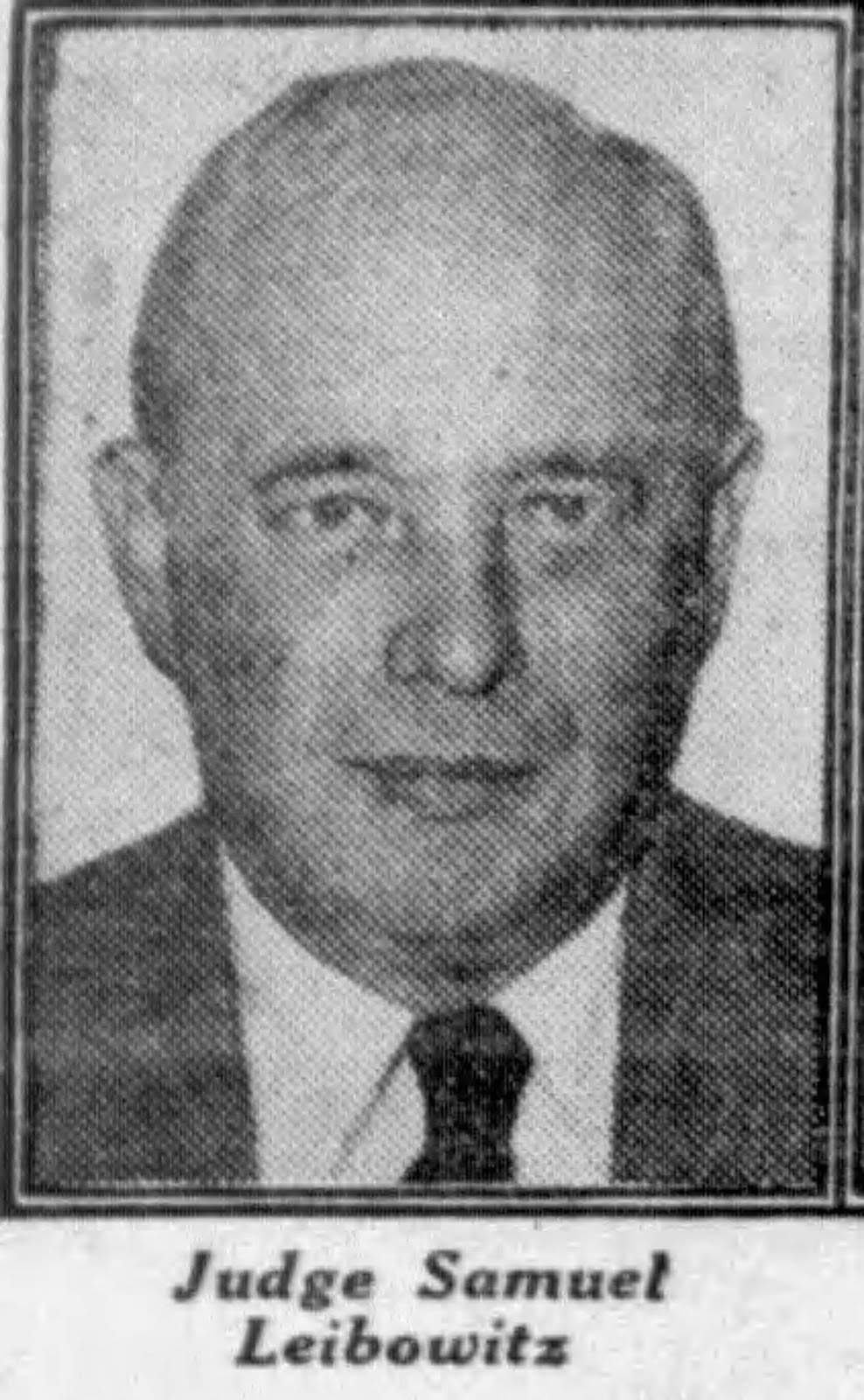
A Grand Jury handed down an indictment on May 18, 1950. Martha's trial before Judge Samuel Leibowitz was scheduled to begin Monday, June 26, 1950. Martha now had two court-appointed attorneys fighting for her. The charge was second-degree murder.

Daily News -
Nov. 27, 1950
Samuel Leibowitz was a tough but respected judge and a bit of a celebrity stemming from his days as a criminal defense attorney and most notably the years he spent (1931-1937) working to overturn the Scottsboro Boys convictions.


Daily News,
Sept. 26, 1933

Chief counsel for the defense of Martha Hochfeld was Leo Healy. Healy was a former magistrate who had resigned from the bench on March 21, 1933 following some minor personal and professional scandals including accusations of habitual drunkenness, questionable rulings and battery of his sister-in-law Estelle Cummings (which she denied).


Charlotte Rachlin,
Brooklyn Eagle
Feb 20, 1939
Charlotte Rachlin, a strong believer in the Public Defender System and a sympathetic soul, was also on board. For years, before becoming a lawyer, Charlotte had supported herself by playing in an all-girl band. Charlotte knew the importance of earning her own money and she knew what it was like to argue with a husband over the household expenses, as she and her husband Dr. Bernard Pines often found themselves doing just that. 


Daily News -
Nov. 27, 1950
Before the trail began, Leo Healy announced his intention to proceed with a defense of temporary insanity. Healy and Rachlin even pooled their own money to have Martha examined by a psychiatrist. Martha was claiming she blacked out before striking the first blow.
From the witness stand Martha told the all-male jury of the abuse she'd suffered at George's hands and of his miserly ways.
District Attorney John E. Cone readied his rebuttal and character witnesses. Martha recognized four of these witnesses on her way out of court on Tuesday the 27th and immediately told her attorneys that she needed to speak with them.

It would seem that investigators for the District Attorney office had discovered those unexplained circumstances Charles Schinitsky referenced but rather then vindicate Martha, these revelations would be her undoing.

The four men Martha had spotted in the courthouse were prepared to testify that they knew her as Martha Kulick and that they had all made her acquaintance at the Arcadia Ballroom on 53rd and Broadway in Manhattan were she worked as a taxi-dancer. Kulick was Martha's maiden name.

Arcadia Ballroom in 1933 -
NY Public Library Digital Collection

1930s postcard showing the interior of
the Arcadia Ballroom, 53rd & Broadway, NYC
The most damaging statement would come from Santo Ciapponi, a 26-year-old restaurant worker living in the Bronx, who claimed he had met Martha in November of 1949 at the Arcadia Ballroom and that she had introduced herself as a childless widow..

According to Santo, he and Martha had, on 4 separate occasions, spent the evening together at a Manhattan hotel. Additionally, one week before George's murder, Martha told Santo she was pregnant with his child at which point he proposed marriage.

Martha denied having relations with Santo Ciapponi. "I've never been in a hotel in my life," she asserted but Martha did admit to her attorneys that she was working as a dancer and that she had been intimate with men other than her husband.

Sensing these admission would irreparably damage his client's defense, Leo Healy felt it was in Martha's best interest to plead guilty to manslaughter.

The following day, June 28, 1950, Judge Leibowitz accepted Martha's plea of guilty of first-degree manslaughter.

Daily News - April 24, 1950
Determined to put a sympathetic spin on the situation, Leo Healy told the court that Martha revealed to him that "she so loved her children that she was willing to sell her body and her soul to provide for them."

"To some, this argument would appear specious and such persons would argue that this woman has no moral sense. Now, your honor, a woman's mind is beyond the ken of men. I do not know whether it is true, but she has said that what she did she did for her children."

Judge Leibowitz did indeed find that argument specious and branded Martha Hochfeld a "prostitute at heart" who should never be allowed the custody of her five children.

District Attorney John E. Cone was equally determined to set the record straight regarding the victim. "We don't want the memory of a decent man besmirched," Cone asserted. His investigation had shown that George Hochfeld was "a good and decent man." The house at 839 Midwood Avenue was in both of their names and well-furnished. And while the neighbors thought well of George, they had a much harsher opinion of Mrs. Hochfeld. The District Attorney maintained his belief that "the child she carries belongs to one of her lovers." This was the moment Louis Hochfeld had advised "Mrs. M.D." to wait for.

Martha Hochfeld was in court again on September 5, 1950 to learn what her punishment would be. Judge Leibowitz expressed true disdain for the woman before him. "Look at her .... not even a tear," he observed. 

"She is a neglectful mother who gallivanted with the scum of the earth.


True Detective Magazine -
January 2015 
"I am thinking of those children who are now in an orphan asylum, their father murdered, their mother branded a felon. I have tried to find one shred to which I could cling that would warrant giving this woman consideration..."

Judge Leibowitz imposed the maximum sentence of 10 to 20 years. Her unborn baby was due in October.

"God help that poor little child about to be born in a cell behind prison walls."

Martha Hochfeld was pale and impassive as she heard the ruling. Martha was transferred to Westfield State Farm, or as we now know it, Bedford Hills Correctional Facility.

I see from the copy of Martha's prison intake form, which I obtained from the NYS Archives, that she was employed by the Arcadia Ballroom from September 1949 to March 1950 and her weekly salary was $65.00 a week.

On June 15, 1951, Louis Hochfeld became the administer of his brother George's estate. According to papers on file, the value of the estate was the $2,000.00 equity in the Midwood Street house.

The Hochfeld children were sent to the Pride of Judea Home.

Hopefully all of the Hochfeld children did as well as Phyllis. In 1956 she was elected Purim Queen and met Mayor Wagner.

Daily News - Feb 25, 1956

The orphanage was  good one although there was a tragic blemish on it's record stemming from an incident that occurred years before the Hochfled children came to live there.
On August 8, 1933, while on a group outing to Edgemere Beach in the Rockaways, seven children were swept away by a powerful undertow and drowned.

The Pride of Judea Home stopped accepting new admissions in 1954 and in June 1958 arrangements were made to relocate for the remaining 30 adolescents. Only Jean and possibly Phyllis would have been young enough in 1958 to have been impacted by this - if they were even still living there.

According to a memoir written by Charlotte Rachlin's son Paul Pines, entitled "My Brother's Madness," the Hochfeld case impacted his mother immensely. Charlotte was disappointed with the sentence handed down and the judgment of the public. Ten days after Martha was led away to begin her prison sentence, Charlotte left the family home and never returned. Charlotte would later divorce Dr. Pines. Charlotte married again when Paul was 12-year-old and she would become an even more outspoken advocate for her female clients. She made frequent appearances on talk radio and a December 3, 1966 listing for the Barry Gray show identifies Charlotte as "a legal expert on paternity suits usually defending the woman in the case." She died on December 28, 1975 after being diagnosed with terminal cancer.

I bought "My Brother's Madness" hoping to learn more about Charlotte Rachlin and I did. However, it's a good read even without tying it to this true crime.

True Detective Magazine -
January 2015 
Martha Hochfeld was eligible for parole in February 11, 1957, paroled on September 3, 1957 and after April 26, 1970 she was no longer required to report her whereabouts to the state parole board. I've lost track of her after her parole. If she's still alive, and it seems inconceivable, she'd be celebrating her 101st birthday next month.

If you want to see Timothy Hutton as Samuel Leibowitz, watch the 2006 movie "Heaven's Fall."

 I don't know about you but I can't see a story about taxi-dancers and not think of the Vicki Lawrence song "Dime a Dance." With that in mind, this seemed like a good opportunity for me to make a very brief (45 seconds) slideshow set to the chorus of that song. You can find it on the As Close To Crime YouTube Channel. Here's the link - https://youtu.be/R8W1d309A0Y

Tuesday, September 11, 2018

Gypsies, Tramps & Thieves

"Mrs. Creedon:

Your daughter will die just like Florence McDonnell.
The Police will never know who murdered both.
I will give your house the once-over until I see how easy it will be for me.

signed - THE UNKNOWN"


Daily News photo-
June 21, 1932
When the body of 5-year-old Florence McDonnell had been found on February 4, 1932 there was fleeting but genuine suspicion that the intended target might have been Nora Creedon's granddaughter.

An attack on Mrs. Creedon's daughter would have been payback from the band of gypsies she had recently ejected from a store she'd leased to them. The address was 232-A Ralph Avenue, Brooklyn. It was in the cellar of that building that Florence's body was found. The Creedons lived next door to the McDonnell family on Chauncey Street. Chauncey Street is only 75 feet from the store's location. Florence had been known to play with some of the gypsy children and she was similar in appearance to the young Creedon girl. Armed with significant circumstantial evidence, police quickly rounded up and questioned dozens of gypsies. This was widely reported in the newspapers.

Deputy Chief Inspector Vincent J. Sweeney told the press that he was not inclined to continue with this line of inquiry - "I have heard of gypsies stealing and kidnaping but in my experience I cannot recall a case where they committed murder."

The day of Florence's funeral, February 8th, police arrested and detained Fred Hicks, the last man seen with Florence. John Hugo, a Salvation Army chaplain, told police that he had seen Hicks and Florence together the afternoon of her disappearance (February 3rd) and he had even overheard Hicks promising to buy Florence some candy. Two candy wrappers were found at the crime scene.

Fred Hicks offered up an alibi but his it was his word against that of a Salvation Army chaplain so he was held until police had a chance to confirm his story. Why, yes Fred Hicks had been purchasing insurance policies that day and two agents backed him up and produced the paperwork as evidence.
Daily News photo -
February 12, 1932

Now it was John Hugo's turn in the hot seat. John Hugo ultimately admitted to police that he was just seeking some attention from the newspapers when he pointed at Fred Hicks and made him the prime suspect in a murder case. Hugo also admitted that his judgment that day might have been affected by an morning spent in City Hall Park, Manhattan drinking "smoke," which is a combination of denatured alcohol and water.  Police discovered Hugo had previously been an inmate at Dannemora Hospital for the Criminally Insane as well as Bellevue. John Hugo had a criminal record dating back to 1911 (mostly for theft but there was a 1927 arrest for assault and battery) and Hugo was an army deserter.  He was thrice married and inserting himself into a police investigation was nothing new for John Hugo. In 1917, while incarcerated on a burglary charge, he claimed to have knowledge concerning the murder of Ruth Cruger. This was, he admitted, a ruse to get out of prison; he actually knew nothing about that crime. John Hugo was held without bail, as a potential material witness but since he had witnessed nothing and was not credible, I imagine the police just wanted to punish him in some way for hindering the investigation with false information. Hugo's own wife, Zilla McBane Hugo, was one of the first to call him a liar. She, John Hugo and their landlady were discussing the McDonnell murder the first day news of it appears in the papers. When they read about the candy wrappers being found at the scene, John Hugo said, "I wonder if the man who took her there offered her candy?" And so it began.... The Salvation Army quickly distanced themselves from John Hugo and rightly so. Hugo had only signed up with the Salvation Army shortly before Christmas and his job was not that of chaplain but he was selling "War Cry," the official publication of the Salvation Army and Hugo had not yet turned in any of the money he collected while performing this task.

Florence had been strangled to death with a length of wire, wrapped multiple times around her throat. Her body seemed arranged and her head was resting on a football. Early medical examinations indicated she had not been raped. Concrete behind the building was busted and what looked like a too shallow grave had been dug in the yard behind the building but abandoned before being used. A baby carriage was placed over the three foot long hole.

Police arrested an additional 5 suspects at Florence's funeral on February 8th. One hundred police investigators were assigned to this case.

Every known degenerate was considered and interrogated. While this did result in arrests for other unrelated sexual assaults, it wasn't until the above anonymous letter was received by Mrs. Creedon several days after the crime that Detective Thomas Cavanagh had something solid to investigate in the McDonnell case.

Detective Cavanagh felt the handwriting was that of an immature individual; also he believed the placement of Florence's body indicated regret on the part of the killer. Cavanagh made photostats of the threatening letter and visited local schools hoping someone would recognize it.

Daily News photo -
July 21, 1932
Miss Helen T. Daily, principal of P.S. 70, thought the handwriting was similar to that of 6th grader Robert Smalls, aged 14. Attendance records reveal that Robert was absent from school the day that Florence was murdered. P.S. 70 is also the school Florence attended.

Robert's teacher dictated lessons that contained several of the words from the threatening letter and a comparison was made. A handwriting expert declared a match.

Detective Cavanagh interviewed Robert's friends and ultimately heard something very damning from 15-year-old Justin James, who they caught up with at the Juvenile Reformatory on Randall's Island. Justin told police that he was with Robert Smalls on the afternoon of February 3rd and when Robert saw Florence he said "There goes that little snitch that got me in trouble at school. I'll fix her. You wait here for me." According to Justin, Robert followed Florence into the Ralph Avenue location and returned 20 minutes later saying only, "I only went in there to look for a bike"

Shortly after that supposed incident, on February 3rd, a truant office scooped up both Justin James and Robert Smalls. Smalls was delivered to his grandparents, who promptly ordered Robert to return to school. James was transported back to Randall's Island, from where he'd escaped.

On February 16th, Detective Cavanagh brought Robert in for questioning. Smalls denied writing the letter and killing Florence. Apparently, at one point Smalls did admit to killing Florence but he later claimed it was all a joke and he was released.

On February 19th the police rearrested Smalls and arranged for a Randall's Island reunion of Justin and Robert, hoping that when confronted by the testimony of his friend Robert would confess. However, Justin changed his story and claimed he'd never implicated Robert Smalls.

Back at the station house, after hours of questioning, Robert Smalls finally confessed to killing Florence by saying "If you want to call it that. I just put my hands on her and she fainted like in my arms." Robert confirmed Florence had "snitched" on him to school authorities on a day he'd played hookey and that he held a grudge. Robert claimed he had followed Florence into the house on Ralph Avenue, carried her into the cellar, she fainted and he wrapped the wire around Florence's neck to scare her but didn't think he'd made it so tight as to kill her. It wasn't until in school the next day that he heard she was dead.

Brooklyn Daily Eagle photo -
February 21, 1932

District Attorney William F.X. Geoghan wasn't entirely convinced of Robert's guilt but proceeded anyway because he had a signed confession. Robert Smalls would later retract this confession. Robert didn't claim abuse by the police but said simply that he'd thought admitting to the crime would somehow help him.

Having been declared sane by two alienists, Robert Smalls was scheduled to stand trial on a charge of first degree murder. This would have been the first time a defendant under the age of 16 had come before the court on a capital charge. 

On June 20, 1932, it was reported that a Grand Jury's findings had resulted in the charges being reduced to 2nd degree murder and the Court of Appeals ruled that a juvenile charged with a felony can only be tried if the penalty is death or life imprisonment. The murder indictment against Robert Smalls was thrown out and the case was to be referred to the Children's Court. 

One month later, armed only with circumstantial evidence and no confession, District Attorney Ralph K. Jacobs was still having trouble pursuing the murder charge against Robert Smalls so on July 20, 1932, Children's Court Justice Peter B. Hanson ordered the charges against Smalls be dismissed because to "keep the petition hanging over this boy's head is not in keeping with the theory of this court."

Pinterest photo of random
gumball slot machine
Not wanting Robert Smalls to go completely unpunished, the District Attorney's office did what they could and managed to convict Robert as a juvenile delinquent and parole violator.

It seems that prior to Robert being arrested in February 1932 for murder, he had already two arrests under his belt. Robert had been caught breaking in to gumball slot machines then released on probation in December 1931 but he violated the terms of the parole in January 1932 by stealing a bicycle. It was for these offenses that Robert was sent to the House of Refuge (a juvenile reformatory).


Now here's the thing - what if Robert Smalls really hadn't killed Florence McDonnell?

There were a rash of rapes and murders of young girls around that time and in that area of Brooklyn, many of which went unsolved. I'm going to focus briefly on 5 of them.

-Sarah Burroughs/Burrows (aged 10) on May 7, 1931
-Florence McDonnell (aged 5) on February 3, 1932 (*)
-Helen Sterler (aged 6) on January 5, 1933
-Barbara Wiles (aged 6) on March 28, 1933
and finally 
-Paula Magagna (aged 8) on July 31, 1937

I used Google Maps to pinpoint the string of murders


Sandwiched in between these homicides were numerous
sexual assaults on children who fit the type but often the assailant was interrupted or scared off so  - who's to say the body count wouldn't have been higher. Of course, it would ridiculously naïve of me not to consider there were multiple men at work during this time period.

I'd be inclined to remove Sarah from this list because, at age 10, she was slightly older than the other victims and she was the only non-white in the group however, every other aspect of the crime fits the pattern.
Sarah was sent to the grocery prior to school to make a small purchase and she never returned. Her body was found in the basement of her own building. She'd been brutally raped, strangled and her body tossed in a coal bin. She'd been gone a mere 30 minutes before the alarm had been sounded and folks began looking for her.

Daily News photo -
November 5, 1931
All of these attacks happened in a relatively small section of Brooklyn. 
All of the girls were raped. (*Although the earlier reports on Florence's postmortem didn't indicate rape, an article in the February 12, 1950 edition of The Brooklyn Eagle says she was.) 
All of the murders occurred in cellars or basements where the victims were lured rather than forced, all of the girls were garroted with lengths of rope or wire that the police believe the killer found at the locations.
The bodies were either found in coal bins or draped across something. Also a baby carriage figured prominently in at least three of the crime scenes although nobody really knows what the significance of this is; it could simply be coincidence because a cellar is a good place to store a baby carriage that you're no longer using.
On January 25, 1933 Helen Sterler had been reported missing by her parents as nighttime was approaching. Neighborhood shopkeepers recalled seeing Helen coming in with pennies that afternoon and making purchases. It struck them as odd because they knew the child well enough to know she didn't usually have money. Shortly after 11PM her body was found in the basement 1013 DeKalb Avenue. This was 5 doors away from her home and less than a mile away from where Florence's body had been found the year before.
Daily News photo - January 26, 1933

Daily News photo -
February 11, 1950

Barbara Wiles had been strangled with her own jump rope in the basement of the 6-family apartment building. On the morning of Wednesday, March 29, 1933, Barbara's unemployed father Harold Wiles walked two blocks to the Police Station to collect a bag of coal for the family. Anna Wiles asked her daughter to pop down into the cellar to fetch a baby carriage. Fifteen minutes later, Anna went down the cellar looking for Barbara. Surely, it shouldn't take this long; their apartment was on the first floor. In the dim light of the basement Anna saw Barbara's body - the jump rope wrapped around her throat and tied tight with a long iron spike. A burlap sack lay nearby. Police suspected the killer might have intended to conceal Barbara's body in it. An ambulance raced to the scene and though some sign of life was detected she would not be resuscitated. Her murder again occurred within that one mile radius. Police rushed to investigate and rounded up suspects. There were also no shortage of kooks confessing then recanting. Assorted degenerates were questioned and released when their alibis checked out. Police were never able to find Barbara's killer.


Daily News photo-Jan 28, 1933
It's interesting to note Price
demonstrating how he strangled Helen
since the autopsy showed she was  garroted.


Of the first four listed, only Helen Sterler's death resulted in an arrest and conviction. Lloyd Price, who had two previous convictions for molesting small boys, was described as feeble-minded and while he claimed police beat a confession out of him the jury had not trouble finding him guilty. Police also liked Price for having committed the two earlier crimes (Borroughs and McDonnell) because they were so similar to the murder of Helen Sterler but they had no evidence with which to definitively link him to those deaths. He was put to death in the electric chair on March 1, 1934.

On August 3, 1937, rooming house manager Mrs. Miriam Satakin walked in on Lawrence Marks and an 8-year-old girl. Marks tried to explain away the situation but Mrs. Satakin didn't believe him for a minute. She removed the girl from the room and called police.
Mrs. Satakin had a very good reason to be so suspicious because she had lived at 1009 DeKalb Avenue in 1933 and her son Arnold had been a playmate of murder victim Helen Sterler.
By the time police arrived on the scene Lawrence Marks had disappeared. He returned 4 days later but Mrs. Satakin had been waiting for him. She quickly called police and he was apprehended. She then learned that Marks was a known sex offender with convictions for sexual assault going back to 1914.


Daily News photo -
October 24, 1937

Daily News photo -
August 9, 1937

On August 8th 1937, after 13 hours of interrogation, Lawrence Marks confessed to killing Paula Magagna but refused to admit any connection to either Florence McDonnell or Barbara Wiles. Marks accompanied police back to scene of the crime and explained how he had met Paula Magagna at the subway station at DeKalb and Wyckoff Avenues. He asked her where she lived and if she knew where the gas meters for her house were. Paula answered yes and took him to the cellar. Once inside the cellar Marks blocked Paula's exit, he strangled her with a length of rope he had found in the cellar, raped then killed her and took the trolley home. According to Marks, he was suffering from a guilty conscious afterwards and contemplated turning himself in to police. Instead he lured another child into his room.
Good thing Mrs. Satakin was on the ball.


Daily News photo -
August 9, 1937 


Mrs. Ida Marks, wife of the accused, apparently knew about his criminal past, would dutifully visit him in prison and long for his release. She claims that in 25 years of marriage they only lived together for perhaps 1 solid year without interruption. And by interruption, she obviously means his multiple incarcerations. She would die in the hallway of her rooming house at 809-A Greene Avenue She was 47-years-old. Lawrence Marks, aged 49-years-old, died in the electric chair at Sing Sing on June 2, 1938.


If you look at the criminal history of Lawrence Marks, as printed in the August 9, 1937 edition of The Daily News, it seems as though he might have been at liberty for all of the murders. 
reprinted from Daily News -
August 9, 1937

Marks was incarcerated 1914-1926 on a morals charge. In 1927, he was sentenced to 6 months to 3 years for impairing the morals of a minor. Marks had violated his parole some time in 1933 and returned to prison but was released from Sing Sing on June 13, 1937.

I would be remiss if I didn't pass along the fact that in February 1950, Anna Wiles came forward to publicly accuse her recently deceased father Charles Gunkel of murdering her daughter/his granddaughter Barbara Wiles. She claimed to have been made aware of his guilt around the time of Barbara's funeral, in 1933, but was sworn to secrecy by her mother Louise, who died in 1939. Now with both of her parents dead and her mother and daughter each appearing to her in dreams, Anna felt the time was right to tell the police the truth and as further evidence of divine intervention - Detective Godfrey Delano of the Ralph Avenue precinct called upon her one afternoon to follow up on the cold case. Anna finally told police something she should have told them at the time - that her father had visited their home on the day of Barbara's death, he had deviant sexual leanings and that his own wife suspected him of the crime.

Daily News photo -
February 2, 1950

Her claims were immediately disputed by her three siblings.

I can see no further police or legal action taken despite the DA's office announcing they would be reopening the cases of Florence McDonnell and Sarah Burrows in light of this new testimony.

Saturday, April 14, 2018

An Intriguing Reveal


I'm not going to use this blog entry to tell the story of Ed and Celia Cooney but instead I want to suggest you read the book "The Bobbed Haired Bandit" by Stephen Duncombe and Andrew Mattson.


Their research methods are very similar to mine in that they rely heavily on newspaper archives. I doubt I'd uncover something they didn't. Plus, they each have the benefit of a formal education and do a very good job of telling not just the Cooneys' story but placing it in the context of everything else that was happening both politically and socially in NYC at the time.

Maybe you'll be sold on this book for the same reason I was?

Imagine your 85-year-old mother, who is suffering from Alzheimer's, routinely wandering away from her Florida home and starting to walk back toward NYC until the police locate her and bring her back. Now, imagine your mother tells you that she's worried "They'll find out who I am." And who is that? Why, "The Bobbed Haired Bandit," of course. Who? Everyone assumed it was the Alzheimer's talking.

Ed and Celia Cooney
Celia Cooney was very big news in 1924 and was still worthy of the public's attention in 1936. However, her exploits were all but forgotten by 1989 when Celia made this confession to her youngest son Ed, Jr. It was only after Celia's death that he and his older brother Patrick learned the truth about their parents' crime spree.